Embodied Resistance: Protective Presence in Palestine
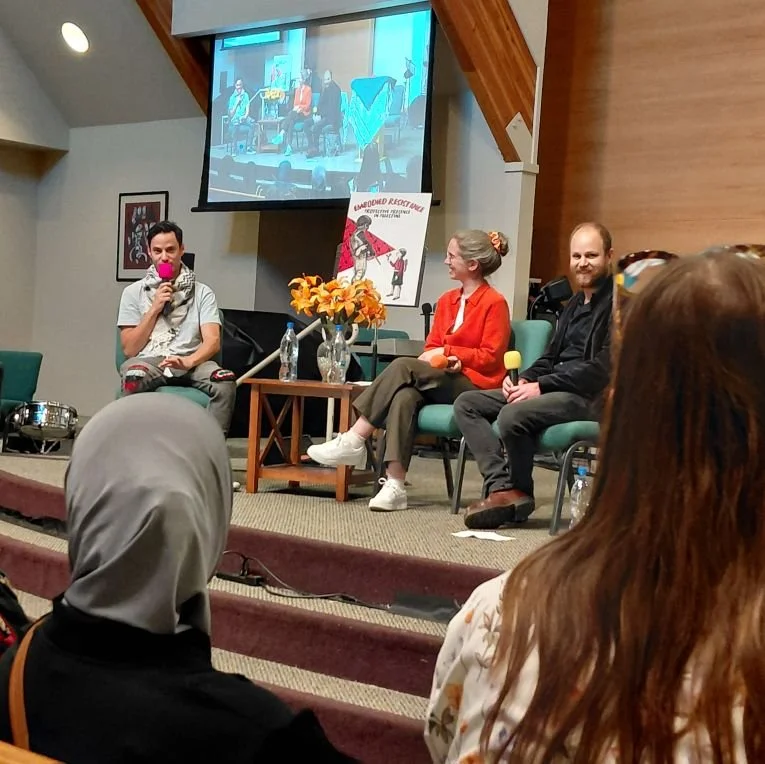
Left to right - Sam Stein and members of Sacramento Jewish Voices for Peace
This past week Sam Stein spoke at Parkside UCC and told his story of gaining political consciousness and becoming a dedicated advocate for Palestinian rights and freedom. From being raised far-right, to putting his life on the line every time he is doing protective presence work, Sam shared his stories of hope, struggle, and resistance.
Sam Stein grew up in a neighborhood on Long Island, in a community of what he calls “a bunch of rich, Orthodox, Republican Jews LARPing as WASPs." His family was Orthodox, politically far-right, upper-class, and in a lot of ways Sam didn't even know that he was so sheltered until he was an adult; he brought up the example of thinking Barack Obama was a Muslim until he was like 20 years old, and being okay with that fact! Sam was always more liberal leaning (with a lowercase "l" he says), but he would vocally support homosexual marriage and oppose racism even in his completely red neighborhood. However, because of his upbringing, he just didn't really question the narrative that he had been told all his life that Palestinians didn't really exist, they just wanted Israel's land, and so on.
After high school Sam ended up in an army prep program in an illegally-occupied settlement in the West Bank. While there he saw things that just did not sit well with him, such as the fact that Palestinians were required to have different license plates from the Israelis, which reminded Sam of the Jim Crow segregation in the US. However, as he was only 18 at the time and away from home for the first time, he didn't dwell on these things for too long and didn't really process all of it at that time.
Sam did not continue on to the army and instead returned home and went to college, getting a degree in English Lit. He stopped observing Orthodox Judaism, and slowly became more liberal, however was still largely apolitical. However, when Donald Trump ran for president in 2015, that changed everything for Sam.
Seeing the adults of Sam's family and community rally behind Trump really showed Sam where he stood politically, because he could see that he didn't want to be anything like that. At the same time, a lot of people he trusted were rallying behind a man called Bernie Sanders, and suddenly Sam realized that these things he believed in, like people's basic needs being met, were not insane and crazy beliefs. This was really when Sam got more involved in politics.
Around the same time Sam had a friend who started being really outspoken about the occupation, and really started challenging Sam's beliefs about it. While originally this made Same quite angry and confused, he also began to unpack some personal biases and really look at the truth of the matter. He worked on his internal beliefs, and really realized that it was an occupation, it was murder, and it was apartheid. He was able to see news stories more clearly, and see them for what they were, rather than what the headlines wanted them to be.
After college Sam spent time in Israel and Palestine, just walking the streets and seeing the sights, as well as in Japan and Cambodia, but Palestine was always calling him back. He returned to Israel on July 31, 2019 and reached out to all the local activist groups before getting connected to All That's Left: Anti-Occupation Collective.
Unfortunately, the work there has changed drastically. While Sam used to do things such as help in family gardens, now it's more like helping to guard those just trying to get water from a well. He was attacked doing that very thing back in 2021, just trying to guard a Palestinian boy getting water, and settler boys attacked Sam, and yet Sam was the one who got arrested, interrogated, and banned from the West Bank for two weeks.
When asked if the broader Israeli society is aware of what's happening in the West Bank, Sam said that no, they aren't very aware at all. There's unfortunately a big problem where the Israeli army is worshipped by the people, yet the settlers are a social pariah. So settlers = bad, settlements = fine. There have been trends of attention toward settler violence, but then it dies down again, so in general, the public is just largely unaware.
Israel's end goal is to have all of the land, and to have Palestinian's under their complete control, or to kick them out completely. If that means they flee, fine, but if that means eradication then that's fine by them as well. That means it's our job to continue to show up. Direct action is what is needed most right now. Rallies, protests, and fighting the funding of Israel. We need eyes on Palestine. We need to keep drawing attention to this issue. Also, donate! Wherever you can, donate. Palestinians have no food, no water, so donate wherever you can. And go to Palestine if you can! It is hard, but not difficult, and very rewarding.
Finally, we want to bring attention to Sam's dear friend Awdah. He was a very friendly and welcoming man, always open to welcoming foreigners and activists in, and he dedicated his life to nonviolent resistance. On July 28, 2025 he was shot dead by an Israeli settler while filming an excavator uprooting the village's olive trees. He was only 31 years old.
Please check out this link for more and to donate to Awdah's community.
LEARN MORE:
Dignity for Palestinians Campaign - Independent, on-the-ground Palestinian-led campaign aiming to preserve dignity of Palestinians in Gaza through emergency health and wellness assistance.
Protect the Harvest - The olive tree holds deep meaning for both Palestinians and Israelis.
For Palestinians, it is a powerful symbol of identity, heritage and deep-rooted connection to the land passed down through generations.
The olive harvest is a key source of income for many Palestinian families. Olive oil, pickled olives, and related products support households and local economy. As land in the West Bank faces increasing threat of confiscation and trees are often uprooted, the olive tree has come to symbolize steadfastness (Sumud).
For many years, the harvest season was a joyful time; a social and cultural moment when families and communities gathered to pick olives together, sharing food, stories, and traditions.
In recent years, however, it has also become a time of fear. Increasing violence, restrictions on access to land, and the risk of harassment or attacks have made it dangerous for many farmers to reach and work their fields. What was once a season of celebration is now often marked by uncertainty and the need for protection.
For many Israelis, the olive tree and olive oil hold deep spiritual meaning. Through Jewish texts, the olive branch is widely recognized as a symbol of peace, originating from the story of Noah’s Ark, where a dove returns with an olive leaf after the flood. Olive oil was used in the Temple in Jerusalem for lighting the menorah and for anointing kings and priests, symbolizing holiness and divine presence.
For many, it is a symbol of shared humanity.
Protecting the harvest is not only about this season. It is about protecting a living connection between people, land, and history.